|
Page A3 / The Joan
De Arc Crusader / Wednesday, December 24, 2025
Front Page
A1
/
Editorials A2 /
Food A4 /
Crossword
A5

The amazing all-purpose Bueker backyard
By J. Bueker
There was no component of our Joan De Arc homestead with more lasting
significance to me than our splendid backyard.
Infinitely more than a mere grassy plot
situated behind the pale-yellow structure of brick and wood in which we
abided, the backyard at 3219 was a boundless universe unto itself, the
setting for an endlessly rich variety of activities and extravagant flights
of our kid imaginations. Stepping through the arcadia door into that space
was akin to passing through a magical portal into a wholly different and
wondrous reality of endless potentialities. Here was the veritable canvas
upon which much of our childhood experience was painted.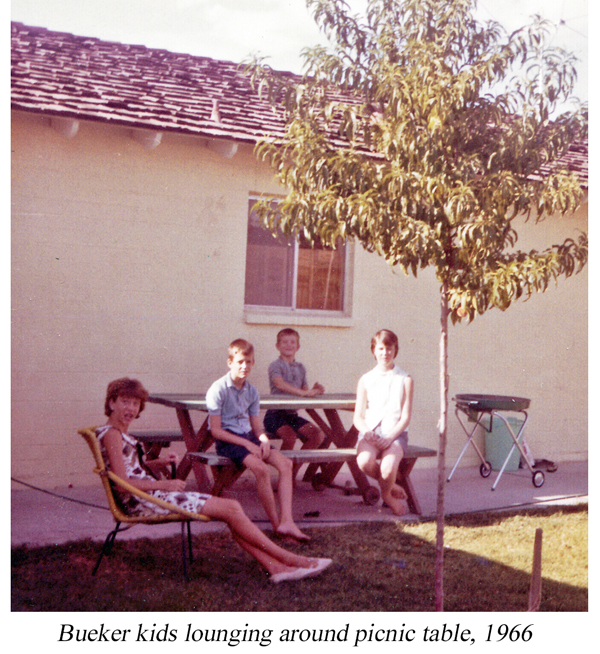
For suddenly we found ourselves
astride an army battlefield under heavy enemy fire, or inside an exotic
spaceship nestled upon the surface of an alien world, a boisterous football
stadium on game day, an observatory unlocking the wonders of the universe, a
dusty Old West town, a secluded campground in the wilds perhaps, or whatever
dimension of circumstance with which we chose to brand it at any given
moment. The tales of the Bueker backyard are of such a rich scope and
variety that I am obliged to condense them down to a precious manageable
sampling. That yard was part and parcel of our life on Joan De Arc.
The Bueker backyard bio properly
opens with the construction of the excellent fence our parents had erected
in 1965 that effectively enclosed and defined the space. For our first year
or two on the street, the backyard proper did not even exist as a discrete
entity since our property merged seamlessly with the neighbors’ yards and so
was possessed of no individual character of its own. Only once that wooden
barrier was in place did our backyard materialize as a distinct environment
with its own uniquely identifiable events.
Our traditional privacy fence was
installed by the American Fence Company of Phoenix and sturdily constructed
of vertical pine slats nailed into neatly arranged horizontal rails, with
each slat featuring a rounded arch-styled top that produced a rather
handsome overall effect. The backyard was now completely enclosed on all
sides with a convenient entry gate situated on the east side of the house. I
have little doubt our immediately adjacent neighbors were very pleased
indeed to see this fence appear as it conferred a degree of privacy and
delineation to their own properties.
Certain elements of the backyard
remained relatively constant throughout our tenure at 3219 and so routinely
became incorporated into the various events concocted therein. The standard
Surrey Heights narrow concrete patio strip ran along the rear of the house
terminating outside the master bedroom arcadia door and here resided a nice
quality wooden picnic table with benches. Purchased not long after our
arrival on Joan De Arc, the picnic table proved a vital focal point for a
variety of different backyard activities over time for our family, myself,
and my street playmates. Ostensibly procured as the dining area for our
occasional outdoor meals, the table and benches were much more commonly
commandeered by us kids for purposes ranging from a space ship or fort to a
grandstand for backyard sporting events.
Backyard cookouts were a very
occasional but most welcome change in our dinnertime routine. My father was
rather fond of outdoor cooking and early on introduced a charcoal grill to
the back porch and later a small hibachi. The backyard culinary fare usually
consisted of your typical hamburgers and hot dogs, but once in a blue moon
we were treated to my mother’s excellent shish kebab recipe, the ultimate
backyard cookout experience at 3219. There can be little doubt that the true
highlight of these grill fests were the charred marshmallows that we toasted
on the end of unraveled wire clothes hangers. Not terribly hygienic in
retrospect but unquestionably yummy.
Another enduring feature in the
backyard was the clothesline that Carl installed at the western end of the
yard soon after we moved in at 3219, which served its designated purpose for
probably only our first couple years on Joan De Arc. Yet that clothesline
was a fateful addition to the yard as it would soon prove useful to us kids
in an eclectic variety of other roles including the base for football field
goal posts and a prop in our frequent “Lost in Space” and “Star Trek” play.
Doubtless the most memorable clothesline episode occurred the day my sisters
somehow became inspired to construct a remarkably sophisticated tent on its
frame using an assortment of blankets and bedding sheets purloined from the
house. The tent was admirably well-conceived with multiple rooms, a door and
roof. The supposed plan was for the four kids to spend that very night
camping out in our new backyard quarters, but I awoke around midnight to
discover my brother and sisters had all called it a night and quietly
absconded back inside to the comfort of their own beds.
The backyard at 3219 was spacious,
grassy, open, and relatively clear of obstacles, making it one of the
premier home sporting venues in the Surrey Heights neighborhood during the
late ‘60s and into the ‘70s, an exceptionally desirable location for
football, baseball, soccer, golf, tetherball and even hockey competitions.
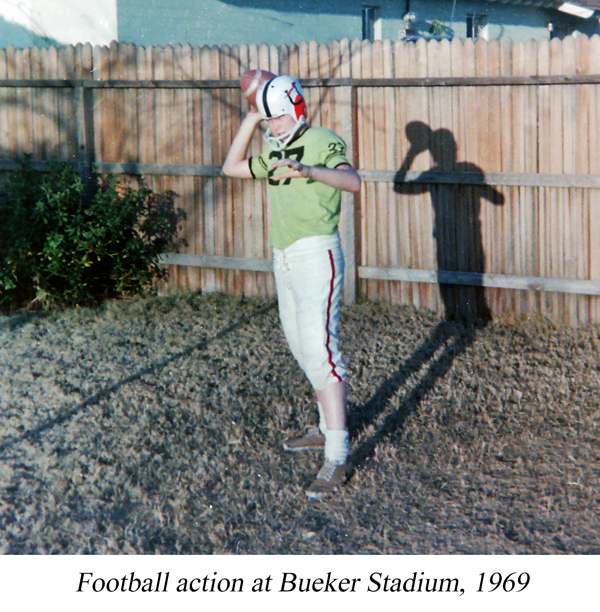
Preeminently, our backyard was the home field for our legendary street
sandlot football team, the three-time Community Football League (CFL)
champion Joan De Arc Cowboys.
The Community Football League was
the brainchild of neighbor Gene Harris and was one of my favorite Joan De
Arc things ever. Gene conceived and organized the league in the later ‘60s,
inviting neighborhood lads to each form their own street teams for raucous
games of backyard (and occasionally front yard) tackle football. Each team
was comprised of roughly a half dozen players and would play both home and
away games, sometimes travelling as far as the Westown neighborhood. Other
notable teams in the CFL were the Joan De Arc Vikings (Gene’s team), the
33rd Avenue Rams, and the Westown Dolphins. The season would culminate in a
championship game at the home field of the team with the best regular season
record. We even held an awards ceremony at the conclusion of each season.
As we all got a bit older, Gene’s
interest in the CFL began to wane and I pretty much took over the league
administration duties by devising the schedules, compiling statistics,
recording results and organizing the games. I didn’t want the thing to end
and my enthusiasm probably kept it going for another year or so beyond its
shelf life.
The Joan De Arc Cowboys team naturally played their home games exclusively
in the Bueker backyard, which I of course christened Bueker Stadium. I seem
to recall designating a tree on the east end of the yard and the old
clothesline on the west as the markers for each goal line, and my brother
and I both experimented with creating scoreboards for the stadium. The
Cowboys team featured some stellar street football talent of the day
including Chris Dickey, Thom Neff and Glen Eide, and we quickly became the
dominant team in the league.
The final CFL game was played in January 1972, as the Cowboys secured their
third and final championship. At this point, interest in continuing the
league was in marked decline and the organization was effectively disbanded
as we all wandered off to high school and other interests, but the CFL
remains a supreme Joan De Arc memory for me. Truly a golden age on the
street.
While football was my preferred athletic activity, there was a rich
assortment of other sports and games played in that backyard over the years
including the legendary Bueker family game competitions such as volleyball,
badminton, and wiffle ball. At one point my father even acquired a croquet
set for the backyard, but I can only remember our family playing this game a
couple times, probably because the croquet field was an extraordinary pain
to set up, what with all those wickets and posts that had to be carefully
arranged and then driven into the ground before play could commence and then
removed upon its conclusion. Before long I was the lone remaining Bueker who
still wanted to play the game and I wasn’t even particularly good at
croquet.
The ‘60s tetherball craze at Sahuaro School inspired my father to install
our very own pole in the backyard which saw fairly regular use for roughly a
year or so before being gradually abandoned. The home tetherball experience
contrasted noticeably with what we knew on the Sahuaro playground, where the
heavy-duty thick metal poles were firmly anchored in a deep rock-solid
foundation of cement. The pole at home was a bit too flimsy and unstable to
deliver high quality tetherball play and the initial excitement of having
one in our own backyard steadily faded.
The Bueker backyard offered an
exceptional view of the night sky, with relatively unobstructed sightlines
in all directions save due north, which of course was partially blocked off
by the house. Light pollution was far less an issue in 1960s Phoenix than it
is today and these characteristics all took on vital importance when my
interest in astronomy blossomed in 1967. The backyard suddenly transformed
into a scientific outpost, an open-air observatory wherein I spent many an
evening conducting astronomical observations of the moon, planets, stars and
eclipses with my beloved Sears reflector telescope.
 The
Sears scope served me well but sadly was not constructed of the highest
quality materials and it started to deteriorate after a few years of use.
Once the telescope’s metal tripod finally became unusable, my brother
resourcefully attached the scope to the old tetherball pole so my
astronomical research could continue on unabated. The old reflector was
ultimately upgraded to a Jason refractor a few Christmases later for our
remaining years on Joan De Arc. I have continued to carry on with occasional
stargazing through the years at various locations, but no backyard since has
offered the grand view of the stars we enjoyed at 3219. The
Sears scope served me well but sadly was not constructed of the highest
quality materials and it started to deteriorate after a few years of use.
Once the telescope’s metal tripod finally became unusable, my brother
resourcefully attached the scope to the old tetherball pole so my
astronomical research could continue on unabated. The old reflector was
ultimately upgraded to a Jason refractor a few Christmases later for our
remaining years on Joan De Arc. I have continued to carry on with occasional
stargazing through the years at various locations, but no backyard since has
offered the grand view of the stars we enjoyed at 3219.
Summertime in the backyard naturally
saw somewhat reduced activity due to the oppressive heat, but even the dog
days offered up memorable phenomena. The cicada population in Phoenix
flourished during this era and I vividly recall our backyard Arizona Ash
shade trees being continuously infested with these harmless yet frightful
flying insects and their remarkably loud singing throughout the summer
months, which provided a sort of grating musical accompaniment to whatever
else was going on back there.
Certainly the prime summer event each year was July the 4th, when the
backyard morphed into a somewhat less than dazzling holiday fireworks venue,
complete with charcoaled hamburgers, chips, watermelon, toasted
marshmallows, and fleeting glimpses of somebody’s fireworks exploding in the
distant sky about 20 miles from our neighborhood. It certainly wasn’t a very
spectacular event from that distance, but the Independence Day fireworks
show at 3219 was possessed of the two most vital possible characteristics in
my father’s eyes – we didn’t have to go anywhere and admission was free.
The backyard plant life naturally evolved steadily over the
years and my mother fought a valiant but decisively losing battle installing
various rosebushes and other flowering plants around the periphery of the
space where we were playing football games and conducting our other various
raucous activities. More than a few of her plants fell victim to this
ongoing circumstance and Barbara ultimately and reluctantly pared down her
ambitions rather steeply in this regard.
One of the more notable botanical
constituents of the yard was a large cluster of incredibly robust agave
plants that was inadvisably planted against the back wall of the master
bedroom at some point and ultimately became a decidedly hazardous nuisance
as they grew to maturity. These things were formidably armed with
hooked thorns along the edge of every leaf and a large sharp terminal spine
at their end, all of which proved quite problematic when an object,
typically a ball, became lodged inside one of them. I suffered more than a
few puncture wounds retrieving baseballs, tennis balls, golf balls, and
footballs from the agaves and we all learned to avoid the things as much as
humanly possible.
When my father one day casually suggested that he might pay me a tidy sum to
remove the menacing agaves from the backyard once and for all, I readily
agreed; however, the man just chuckled, knowing full well the job was a far
too Herculean task for me (or probably even him) to even attempt. That
Little Shop of Horrors was still thriving in the backyard when we departed
Joan De Arc in 1977 and I would not be the least bit surprised to learn they
live there still.
The routine backyard maintenance tasks of watering and mowing were a
responsibility my father originally looked after during the early years
until his two sons were deemed old enough to assist with and ultimately
assume said duties. Carl initially used simple but inefficient oscillating
and rotary sprinklers to water the backyard grass but soon came to favor the
flat sprinkler hoses that emit water upward and outward in a fine spray,
providing much more water coverage over a wider surface. These sprinklers
did a stellar job as our backyard always had a consistently healthy covering
of Bermuda grass, even during the colder months when it all turned an
attractive shade of beige.
The
lawn mowers at 3219 became increasingly technologically sophisticated as the
years passed and I seem to recall three different types being put to use: an
old-fashioned manual reel mower, a gasoline-powered mower, and lastly a
newfangled electric mower. Soon after I had achieved my rite of passage into
the joys of lawn-mowing duty, my father acquired the fancy new electric
mower with his work “points” and the contraption would immediately prove to
present some rather formidable challenges.
Of paramount importance was the
vital necessity of avoiding running the mower over its own electric cord,
which could obviously lead to catastrophic consequences. My dad solemnly
warned me about this grave danger and then went back in the house and left
me to my fate. To my credit, I never did electrocute myself in this manner,
but the cord was attached to the mower in such a fashion that it made simple
up and down mowing of the backyard virtually impossible: the old
back-and-forth 180’s were simply no longer achievable. I was obliged to
constantly manipulate the cord, pick it up, move it out of the way, walk
under it, etc., to prevent it from becoming tangled and falling into my
mowing path. I did become reasonably adept at this process but only after a
couple years of nerve-racking trial and error.
One of my final memories of the old
backyard is one of simply sitting there quietly with my mother on a sleepy
fall afternoon in 1976, some months before we left the street. I spent a few
wistful moments musing over the countless childhood spectacles and dramas
that had unfolded within the confines of that twelve-hundred-square-foot
parcel of sacred soil and concrete: the endless summer days spent playing
“Lost in Space” and “Time Tunnel,” the crisp autumn afternoons of CFL
backyard football competition, the family cookouts and gaming events, the
glorious moons of Jupiter and rings of Saturn -- all those immortal moments
that had somehow slipped away quietly into the past. I was struck by the
realization that much of my fondly-recalled youth had actually played out
right here on this grassy little patch of desert soil mere steps away from
my own back door.
Childhood was a starkly different experience back in that day of course;
there were no cell phones, video games, computers or social media, and but a
tiny handful of TV channels from which to choose. The great preponderance of
our time as kids was therefore spent rollicking about in the great outdoors
and the backyard at 3219 was in essence an indispensable recreational
amenity whose utility was limited only by that which our youthful
imaginations could conjure on any given day. Through the miracle of human
memory, I can still enter that backyard at any time of my choosing, and my
innumerable recollections of the space are possessed of a peculiarly
timeless quality that transcends the daunting reality of impermanence
itself.
_______________________________________________________________________________________________________JDA
Front Page
A1
/
Editorials A2 /
Food A4 /
Crossword
A5
|