|
Page A3 The Joan De Arc Crusader / Thursday, December 25, 2008 Front Page A1 / Editorials A2 / Nostalgia A4 / Crossword A5
Film Review: Revisiting Bueker and Mason’s “Untitled” By J. Bueker If ever there was an environment well suited to the pushing of the cultural envelope, it would have to be the high school fine arts classroom. The combination of hormone-fueled adolescent angst, unfettered creative ambition, and absence of any discernable social self-restraint forms a powerful crucible for the nurturing of artistic expression. This was especially true in the early ‘70s, when American youth were experiencing in full measure the aftershocks of the cultural revolutions of the 1960s.
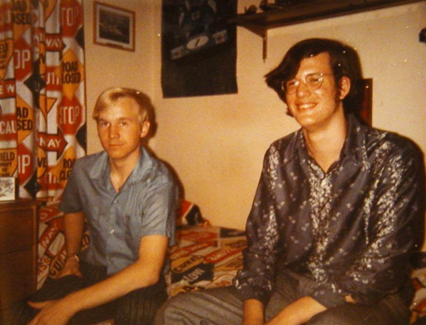
Enter Charles “Chuck” Bueker and Garrett “Tom” Mason, friends and students at Moon Valley High School during this golden age of artistic ferment. In 1973, the pair collaborated on a remarkable eight-and-a-half minute film for their Moon Valley communications class that was so startlingly groundbreaking that a title for the work seemed ultimately pointless. Well either that or they didn’t want to be bothered thinking one up. “Untitled” is a mini-masterpiece of ad hoc post-pubescent provocation. The film is ambitious in scope, unashamedly improvisational, and pleasingly irreverent. Its narrative structure is formed entirely around camera point-of-view shots, the first of several wise choices made in the work’s overall conception, especially given the subject matter -- an examination of the netherworld of altered consciousness. In effect, the viewer is the subject of this fanciful celluloid adventure. After the rather self-aggrandizing screen credits unfold (Tom Mason, we are led to believe, is a “Super-Stud”), we find ourselves wandering an apparently abandoned Moon Valley High campus on a bright and sunny afternoon. The camera pans to reveal a full bottle of “Neapolitan Liqueur” lying on the ground near a classroom building, and so already the film requires of its audience a willing suspension of disbelief. The idea that a discarded alcohol bottle could be found on the Moon Valley campus is entirely plausible of course, but the conceit that it would still contain liquor is farfetched to say the least. Naturally the beverage is consumed, and what follows is a barrage of sights, sound effects, music and general mayhem as we endure the effects of the alcohol “trip.” It is difficult to imagine a high school teacher today accepting such content in a class assignment -- things were a bit mellower in ’73, I reckon. Or perhaps Bueker and Mason rather did not make their instructor privy to the precise nature of their work until it was way too late. Like when they were showing it to the class. Thematically, “Untitled” appears to offer an exploration of the consequences of alcohol abuse, although the ensuing imagery seems more appropriate to the influence of hallucinogens than mere ethanol. That Neapolitan Liqueur must be some powerful stuff. Or was there something else in that bottle of which the audience is not apprised? In any event, the intoxication motif is an ingenious choice, as it can be used as an excuse for carte blanche to film anything and everything the film makers happen to dream up on the spur of the moment. After all, what bizarre tomfoolery does not make sense in the context of a chemically distorted perspective? Such a device cleverly eliminates the pesky need for any sort of coherent story line.
The only consistent character in the whole eccentric daydream is an odd, animated drawing of a grinning gentleman sporting a hat, sunglasses and polka-dotted underwear. He travels obliviously through the ever-changing landscape, and may simply be an avatar representing the person experiencing this odyssey of inebriation (that is, us). Perhaps he is an Everyman of some sort, symbolic of the human psyche or the collective subconscious. It’s anybody’s guess, really. However the most imaginative and engaging sequences in “Untitled” unquestionably belong to the marvelous clay animation pieces. One simply never tires of watching the hapless clay-man head disappear down a toilet that disturbingly sprouts long eye appendages at random intervals. The pathos of the clay man gazing pleadingly at the viewer as he meets his septic fate is broadly enhanced by the sight of the giant tongue that then sweeps out of the anthropomorphized toilet to scoop up the victim’s hat. Terry Gilliam would be proud. "Untitled" is skillfully interspersed with footage from a long forgotten 1950s B-movie sci-fi flick about a large bird that goes on an urban rampage. These fleeting scenes infuse the work with a sense of impending doom that is only allayed at film’s end, as we at last sober up and once again find ourselves at Moon Valley High School, presumably now with a momentous hangover. Our last glimpse is of the dead bird’s claw protruding from a large body of water, over which are superimposed the words “The End.” There seems to be some vague existentialist symbolism at play here. Or not. The ultimate message of “Untitled” is appropriately ambiguous. It appears to either be “Just say no,” or “Hey kids, booze is fun!” Conceivably both. But I leave it to the viewer to decide these subjective matters. “Untitled,” it seems safe to say, remains unsurpassed as one of the greatest avant-garde intoxication film student art projects in the entire history of Moon Valley High School. Teacher Diana Greensweig was probably never quite the same again. 35 years later, this thing is just begging for a sequel. How ‘bout it, guys?
Restaurant Review: “Jade Palace” By J. Bueker
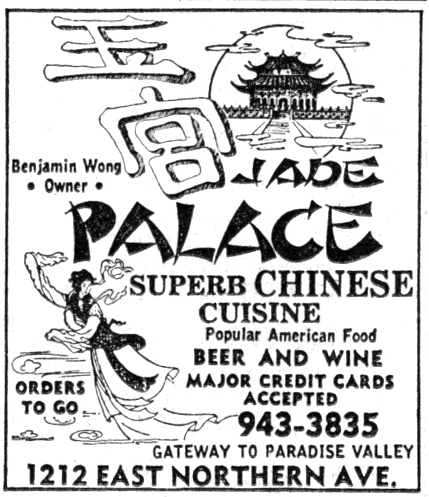
Our family (and this is exceedingly well documented) rarely went out for dinner back in the early days on Joan De Arc Avenue. I suppose this was to some degree attributable to the genuine paucity of eating establishments on the west side of town during this primeval era of Phoenix history, a circumstance particularly true of Chinese restaurants. There was always Toy’s Shangri-La down on East Camelback, a veritable Valley institution, but Toy’s was decidedly pricey and represented a significant excursion from our Surrey Heights dwelling. Need I say more? There did however exist a very nice and relatively affordable Asian diner on East Northern Avenue in ‘60s Phoenix to which our dad would occasionally consent to take the fam, a mere twenty minute drive from 3219: the legendary Jade Palace. The Palace originally opened in 1965 at its location on 12th St. and Northern, an area the restaurant grandly billed for many years as the “Gateway to Paradise Valley.” This was actually a pretty nice part of town at the time, and since there was little competition in those early years, business was very good indeed. Well into the ‘70s, “Jade Palace” was synonymous in the Bueker household with fine Chinese dining. That is, when we weren’t experiencing the joys of “Chun King” from a can. The original Jade Palace business and owners are now long gone, of course. Yet the building remains, and it amazingly still houses a medium-priced Chinese restaurant, which now carries the appellation of Super Dragon Chinese Cuisine. My companion and I recently stopped in for an early dinner at Super Dragon to at last revisit this Asian eatery of my youth, forty years hence. If memory serves, I had last visited the Palace one evening in the late ‘70s with my brother Charles, on which occasion we snacked on some egg foo yung and downed a few bottles of brew. The essential structure and configuration of the building appear completely unchanged from that night: two roughly equally-sized rooms filled with tables and booths joined together to form an ‘L’ shape. The entrance to the restaurant is still enclosed within a small attractive courtyard that is accessed through a familiar brick archway. It’s pretty remarkable how little has changed here in thirty-odd years. My companion and I were promptly and pleasantly received as we entered the establishment, and our gracious hostess seated us without delay in a clean and comfortable high-backed red leather booth. Attractive and elegant abalone shell and black-lacquer scenes of early Ming Dynasty domestic life adorned the walls, and the overall atmosphere was quiet and relaxing, with soft and unobtrusive background music gently wafting through the air. As we examined our menus, the restaurant manager stopped by the table to greet us, and my companion took the opportunity to cheerfully apprise him of the nostalgic nature of our visit, noting that I had supped at this very diner a number of times as a child. The man smiled and tersely acknowledged the advancing age of the building before disappearing to welcome some newly arriving customers.
The impressively expansive Super Dragon menu features all the usual suspects and some unusual ones as well, and so required several moments to properly assimilate. We at length elected to begin our repast with a glass of plum wine and an appetizer of spring egg rolls. The rolls were nice and crispy, though not especially flavorful, while the wine tasted slightly bitter, apparently a brand with which we suffered a degree of unfamiliarity. Not off to a good start here. But all was forgiven with the arrival of our two entrees. I selected the Sizzling Black Pepper Steak, a savory combination of exquisitely marinated beef, red and green peppers, onions, and a delicious garlicky sauce. Sublimely yummy. My companion opted for the Cashew Chicken, a steaming plate of tender and succulent chicken breast portions immersed in a rich sauce with crunchy cashews, water chestnuts, bamboo shoots and chopped celery. Aside from the unusually pungent flavor of the celery, this dish too was near perfect. The prices at Super Dragon are similarly attractive – our total bill came to a mere $30.00. As we munched on our fortune cookies and sipped our tea, we resolved to pay the Super Dragon a return visit in the near future. Of course, all this detail is ultimately of little importance, as this wasn’t really a restaurant review at all. The entire purpose of visiting the old Jade Palace was pure nostalgia for a time and place that long ago vanished down the fading corridors of Phoenix history. And yet there it stands, much as it did forty years ago. Amid the rapidly changing face of 21st century Phoenix, I find this strangely comforting. _________________________________________________________________________________________________________________________JDA
|