|
Page A4 The Joan De Arc Crusader / Sunday, June 18, 2006 Front Page A1 / Editorials A2 / Nostalgia A3 / Crossword A5
The summer from U.N.C.L.E.By J. Bueker One of the
defining phenomena of ‘60s pop culture was an intense infatuation with
international espionage, an inevitable consequence of the intrigues of the Cold
War at the very height of its social influence. Spy films and TV series were
quite the rage during this decade,
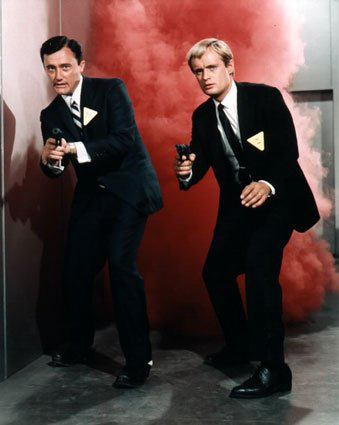
No spy show of the ‘60s however surpassed the remarkable The Man from U.N.C.L.E. for sheer charm and character. Premiering on NBC in the fall of ’64, U.N.C.L.E. was at bottom a spoof of the whole spy genre, but a beautifully played one. The heroes of the show were the gregarious ladies' man Napoleon Solo, precisely wrought by the debonair Robert Vaughn, and the quiet and enigmatic Russian agent, Illya Kuryakin, expertly portrayed by David McCallum. Napoleon and Illya took their orders from the Englishman in charge of the U.N.C. L. E. organization, Mr. Alexander Waverly, played with genuine gravitas and gentle charm by the late Leo G. Carroll. The fact that an American and a Russian were teaming up to fight evil as the Cold War raged was just one of the many thematic subtleties that set U.N.C.L.E. apart from its on-air competition. Of course, so were many of the undeniably silly story lines and camp villain characterizations the show spun for its viewers, particularly during the third of its four seasons, when The Man from U.N.C.L.E. fell under the firm influence of the popular new Batman series. An important element of the show was that the spy gadgetry was first rate – for instance the pocket radio in the shape of a pen with which an agent could “open Channel D” to contact headquarters, which was cleverly located in the back of a New York City tailor’s shop. Pens were also used by U.N.C.L.E. for a variety of other spy functions, such as the recording of conversations and the delivery of knock out gas. Other popular gadgets on the show included cigarette lighters that converted to guns, cigarette packs that doubled as short wave communication devices, and cigarettes that could render an agent instantly unconscious. Cigarette smoking was still extremely popular forty years ago. The young John Bueker swiftly became exceedingly enthralled by this exciting new TV series, as did more than a few of his peers on Joan De Arc Avenue. Soon, kids on the street were chasing one another with plastic cap guns, throwing themselves under bushes, and exchanging carefully coded secret messages. For the Christmas of 1965, my sister Susan saw to it that I received a “Secret Sam” briefcase, which contained a cool spy gun assembly and actual working camera. Thus was my spy career on Joan De Arc officially launched. The next logical step was naturally to join the local chapter of the United Network Command for Law and Enforcement. Forty years later, my eighth birthday remains the most memorable of my childhood. I have no substantive recollection whatsoever of my ninth or tenth birthday, or my twentieth for that matter, but my eighth birthday yet remains vividly clear in my memory, thanks to the Joan De Arc U.N.C.L.E. craze. My gift request that birthday was for the Napoleon Solo Gun set, manufactured by Ideal Toys. The NSG consisted of the standard issue plastic Ideal U.N.C.L.E. cap gun pistol with badge and ID card (which I already possessed), but it also included the accessories necessary to convert the pistol into a 27 inch rifle: a stock, silencer, bipod stand, and telescopic sight. The gun itself had a removable clip that would hold an entire roll of caps, creating a cool puff of smoke that would emanate from the end of the pistol when fired. The building suspense over receiving the gift was somewhat dissipated a couple of weeks before my birthday when I spotted the NSG in the trunk of my mother’s Opel one day when we were removing groceries after a trip to A.J. Bayless. Nonetheless, I was singularly thrilled on Saturday, June 18, 1966, when I took possession of the NSG. I knew that my reputation as the Joan De Arc Man from U.N.C.L.E. would be forever secured with my acquisition of this sublimely cool toy. Sadly, just hours after opening my long-desired U.N.C.L.E. gift, tragedy abruptly struck. Our family had been invited to spend the afternoon at Grandma and Grandpa Swaggerty’s house on Northern and 11th Avenues for the birthday celebration, at which time and place I was to receive an additional, “cool but educational” gift from my grandparents (which turned out to be a very nice globe, which I still possess). As brother Charles and I excitedly dressed for the trip to Howard and Lois’s, I sat down with full force upon my bed, where I had unfortunately placed my NSG just moments before. The impact of my buttocks upon the plastic gun stock cleanly broke the object into two pieces, just hours after I had received the gift. I was needless to say decidedly crestfallen. My father and brother initiated a series of heroic efforts to repair the gun stock with a couple of different adhesive substances, but the quality of the plastic and glue was such that it never did bond effectively. Thus I could never use my Napoleon Solo gun as the cool U.N.C.L.E. rifle it was meant to be. This pivotal event of my young life marked the beginning of a slow decline of the whole U.N.C.L.E. experience on Joan De Arc. As we would say in the 21st century, this was indeed the “tipping point.” Such is the nature of the spy biz, I suppose.
For me, the
Napoleon Solo Gun set would be the ultimate addition to any ‘60s toy collection.
Unfortunately, many of my fellow male baby boomers appear to share this very
same sentiment. On the rare occasions that the NSG in the original box (one
must have the box) Weapons aside, one of the most important aspects of U.N.C.L.E. play was the devising of codes for secret messages. I prided myself in conceiving the original “backward code,” in which the alphabet was simply reversed with Z=A, Y=B, and so on. Oddly enough, this ingenious code was quickly broken by enemy agents. More effective codes soon evolved that involved the use of arbitrary symbols for the letters of the alphabet. Variations on the “kite” symbol were very popular in this regard. Once a coded message was formulated, the problem of concealing it where only the intended target agent could retrieve it came to the fore. I can still recall a number of hiding places that I used in the garage at 3219, including a discarded lamp that we stopped using soon after arriving on Joan De Arc, but that remained in the garage for many years. Playing “Man from U.N.C.L.E” on Joan De Arc was an exceptionally fun and exciting activity. As with the real world of espionage, one could never be absolutely certain whose side the other fellow was on, and deception was often the rule of the day. To complicate matters, archenemy T.H.R.U.S.H. agents could actually be double agents working for U.N.C.L.E., and triple agents were certainly not unheard of in this realm—in a word, appearances could be extremely deceptive. One of the last times we ever played U.N.C.L.E., I fell victim to an elaborate ruse at the hands of Beth Ann Humphries and Terri Gall that still haunts me to this day. Beth Ann and Terri actively and enthusiastically sought me out and recruited me, and me alone, to play U.N.C.L.E. that day, which should have been an immediate tip off right there. The girls’ idea was for a sort of spy “hide and go seek” activity wherein they would play kidnapped U.N.C.L.E. agents whose rescue I would be assigned to undertake by Mr. Waverly back at headquarters. Beth Ann and Terri would quarter themselves somewhere on the block (the Galls lived on Willow Ave., kitty corner to the Humphries home), and my task would be to locate and rescue the girls from certain peril at the hands of T.H.R.U.S.H. agents. Taking them at their word, I spent the next two hours or so combing the neighborhood in a fruitless search before it finally dawned on me that the two were probably safely holed up in Beth Ann’s (or Terri’s) bedroom having a hearty chuckle at my expense. I retired from the service soon thereafter. The Girl from U.N.C.L.E was a short-lived spin off that aired for one season in 1966, starring the lovely Stefanie Powers as agent April Dancer. The show did not prosper, but it did serve to inspire more of the girls on the street to participate in the U.N.C.L.E. play. Beth Ann enthusiastically embraced the role of April, and she proved to be one of the most dedicated and reliable U.N.C.L.E. agents on Joan De Arc. Mention must also be made of “The Man from A.U.N.T.I.E.,” one of the greatest of the Mad Magazine television satire pieces. First appearing in the July, 1965 issue, this excellent spoof of the series featured, among other masterstrokes of parody, the demise of Solo into a boiling cauldron of oatmeal. Incidentally, “A.U.N.T.I.E.” turned out to stand for “Association of Unbelievably Nauseating Television and Idiotic Entertainment.” The final episode of The Man from U.N.C.L.E. aired on January 15, 1968, and the series was replaced in the NBC line-up the following week by Rowan and Martin’s Laugh-In, which would turn out to be one the most successful and groundbreaking series of the late ‘60s. Selected episodes of U.N.C.L.E were released on VHS in the ‘90s, but the long awaited DVD collection of the series has not yet materialized, much to the chagrin of a still extensive fan base. Until then, we will have to content ourselves with diving under some more bushes, opening channel D, and fondly recalling the inspired and bygone era of “Spy TV.” __________________________________________________________________________________________________JDA
|
 ultimately initiated of course by the Bond
films that were first introduced in 1963 with Dr. No. The TV landscape
soon became saturated with the spy craze, offering such timeless tube fare as
I Spy, Honey West, The Avengers, Mission Impossible,
The Wild, Wild West and the hilarious Get Smart.
ultimately initiated of course by the Bond
films that were first introduced in 1963 with Dr. No. The TV landscape
soon became saturated with the spy craze, offering such timeless tube fare as
I Spy, Honey West, The Avengers, Mission Impossible,
The Wild, Wild West and the hilarious Get Smart.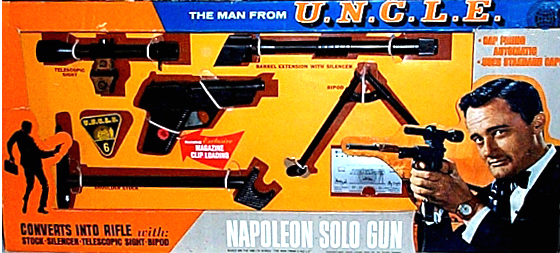 becomes available for auction on ebay,
it routinely fetches in the neighborhood of $2000 or more. Hell, I once saw the box
alone sell for over $1600. I must face the very real possibility that I
shall never have this particular item in my collection of childhood memorabilia.
‘Tis pity, but life can be quite harsh.
becomes available for auction on ebay,
it routinely fetches in the neighborhood of $2000 or more. Hell, I once saw the box
alone sell for over $1600. I must face the very real possibility that I
shall never have this particular item in my collection of childhood memorabilia.
‘Tis pity, but life can be quite harsh.